[Al-Quran 50:6-8] Have they not looked at the heaven above them - how We structured it and adorned it and how it has no rifts? And the earth - We spread it out and cast therein firmly set mountains and made grow therein [something] of every beautiful kind, Giving insight and a reminder for every servant who turns [to Allah].

Sunday, May 17, 2015

World Hunger & Slavery

Population Growth & Food Resources
Morality & Homicide  


Abstract
Quran (6:151, 17:30-31) identifies poverty as the reason for hunger, and dismisses the notion that population growth leads to hunger, explicitly prohibiting the killing of children due to or out of fear of poverty. At another place, the Quran (Surah 90) exhorts the free citizens to reduce inequality by freeing slaves and feeding the hungry, stating that these are the difficult yet required things to do. Quran (2:177) lists giving of wealth to the needy and freeing of slaves among the righteous deeds.

According to the statistics, the agricultural yields are more than enough for the current and forecasted world population, yet one in every nine people on our planet suffers hunger every day! Though decrease in population growth is promoted as a remedy to the problem, yet no direct correlation has been found between population density and hunger. Unjust economic systems lead to Poverty and Inequality,  which in turn cause Hunger, Indebtedness and Enslavement! 

An estimated 21 - 36 million people are enslaved today. Though legal slavery was finally banished from all countries in the world by 1981, yet its only changed in title and form - humans continue to be enslaved by fellow human beings. 

This article explores the meaning of the divine instruction and guidance in terms of the relevant information available.   


Full Text
The Quran repeatedly states that ‘rizq’ is provided by Allah. It warns to not to kill children because of fear of lack of food. 

 …وَلَا تَقْتُلُوا أَوْلَادَكُم مِّنْ إِمْلَاقٍ ۖ نَّحْنُ نَرْزُقُكُمْ وَإِيَّاهُمْ …

[Al-Qur’an 6:151, translator: Sahih International] Say, "Come, I will recite what your Lord has prohibited to you. [He commands] that you not associate anything with Him, and to parents, good treatment, and do not kill your children out of poverty; We will provide for you and them. And do not approach immoralities - what is apparent of them and what is concealed. And do not kill the soul which Allah has forbidden [to be killed] except by [legal] right. This has He instructed you that you may use reason."

وَلَا تَقْتُلُوا أَوْلَادَكُمْ خَشْيَةَ إِمْلَاقٍ ۖ نَّحْنُ نَرْزُقُهُمْ وَإِيَّاكُمْ ۚ إِنَّ قَتْلَهُمْ كَانَ خِطْئًا كَبِيرًا …

[Al-Qur’an 17:30-31, translator: Sahih International] Indeed, your Lord extends provision for whom He wills and restricts [it]. Indeed He is ever, concerning His servants, Acquainted and Seeing. And do not kill your children for fear of poverty. We provide for them and for you. Indeed, their killing is ever a great sin. 

Quran identifies poverty as the reason for hunger, and dismisses the notion that population growth leads to hunger. At another place, it exhorts the free citizens to reduce inequality by freeing slaves and feeding the hungry, stating that these are the difficult things to do: 
[Al-Qur’an 90:11-18, translator: Sahih International] But he has not broken through the difficult pass. And what can make you know what is [breaking through] the difficult pass? It is the freeing of a slave Or feeding on a day of severe hunger An orphan of near relationship Or a needy person in misery And then being among those who believed and advised one another to patience and advised one another to compassion. Those are the companions of the right.  

The following ayat lists giving of wealth to the needy and freeing of slaves among the righteous deeds: 
[Al-Qur’an 2:177, translator: Sahih International] Righteousness is not that you turn your faces toward the east or the west, but [true] righteousness is [in] one who believes in Allah, the Last Day, the angels, the Book, and the prophets and gives wealth, in spite of love for it, to relatives, orphans, the needy, the traveler, those who ask [for help], and for freeing slaves; [and who] establishes prayer and gives zakah; [those who] fulfill their promise when they promise; and [those who] are patient in poverty and hardship and during battle. Those are the ones who have been true, and it is those who are the righteous.


Morality & Homicide 
Killing is a major crime. Hence, where it forbids the killing of children, Quran 6:151 also stresses on: ‘And do not approach immoralities - what is apparent of them and what is concealed.’ Quran 17:31 states that ‘‘…Indeed, their killing is ever a khiṭ'an kabīran’: a grave offence, a great disobedience, a monstrous error, a great sin!  

The Quran 4:1 warns us to keep our duty regarding the الْأَرْحَامَ (the wombs). This Arabic word is generally mistranslated as relations or ties of kinship. For more on this, please read Guarding the Womb.

A horrifying video of the torturous killing in an abortion: The Silent Scream 

Sex, and especially sex outside marriage, may lead to unwanted pregnancies. Scholars have differing opinions on whether contraception is permissible or not, or if only some methods are permissible.  

Some cultures also value one gender over another, especially the girl child is generally unwanted and unwelcome. Consequently, a number of people resort to abortions, especially female foeticide / infanticide. Quran condemns it and will hold people accountable for it: 
[Al-Qur’an 81:8-9, translator: Sahih International] And when the girl [who was] buried alive is asked For what sin she was killed? 

Dating and prostitution are actions which have socio-moral implications, and are prohibited in Islam. More on this at: Is Temporary Marriage the Halal Alternate to Dating?   


Poverty, Hunger & Population Growth 
According to estimates, about half the world population survives on $2 a day.  Consequently, about 805 million people were estimated to be chronically undernourished in 2012–14, which means one in every nine people on our planet suffers hunger every day!    

A key word used in both 6:151 and 17:30-31 is poverty. Contraception and Family Planning are being aggressively promoted to mitigate global population, and the marketing slogan is that less people leads to better sharing of finite resources. However, facts do not support this position: 
‘Do too many people already cause hunger? If that were the case, then reducing population density might indeed alleviate hunger. But for one factor to cause another, the two must consistently occur together. Population density and hunger do not. 
Hunger is not caused by too many people sharing the land. In the Central America and Caribbean region, for example, Trinidad and Tobago show the lowest percentage of stunted children under five and Guatemala the highest (almost twelve times greater); yet Trinidad and Tobago's cropland per person-a key indicator of human population density-is less than half that of Guatemala's. Costa Rica, with only half of Honduras' cropped acres per person, boasts a life expectancy-one indicator of nutrition-eleven years longer than that of Honduras and close to that of northern countries. 
In Asia, South Korea has just under half the farmland per person found in Bangladesh, yet no one speaks of overcrowding causing hunger in South Korea. 
Surveying the globe, we in fact can find no direct correlation between population density and hunger. For every Bangladesh, a densely populated and hungry country, we find a Nigeria, Brazil, or Bolivia, where significant food resources per capita coexist with hunger. Or we find a country like the Netherlands, where very little land per person has not prevented it from eliminating hunger and becoming a large net exporter of food […] 
In 1989 Cornell University sociologists Frederick Buttel and Laura Raynolds published a careful study of population growth, food consumption, and other variables in ninety-three third world countries. Their statistical analysis found no evidence that rapid population growth causes hunger. What they did find was that the populations of poorer countries, and those countries where the poorest 20 percent of the population earned a smaller percentage of a nation's total income, had less to eat. In other words, poverty and inequality cause hunger.’ 

To get a clearer perspective of the issue, the following two speeches are worth listening to: 
Food First: Dismantling Racism in the Food System (Just Food Keynote address by Eric Holt-Giménez)

The Hidden Reason for Poverty the World Needs to Address Now (TED talk by Gary Haugen): 


Modern Day Slavery
Quran 2:177, 4:92, 5:89, 9:60, 58:3 and 90:13 stress on the freeing of slaves, as a righteous deed, as one of the uses of zakat money, and as an expiation of sins. 

An estimated 21 - 36 million people are enslaved today generating billion of dollars for traffickers each year. Though legal slavery was finally banished from all countries in the world by 1981, yet its only changed in title and form, as: Bonded labour, Child slavery, Early and forced marriage, Forced labour, Descent-based slavery, and Trafficking. Humans continue to be enslaved by fellow human beings: ‘from women forced into prostitution, children and adults forced to work in agriculture, domestic work, or factories and sweatshops producing goods for global supply chains, entire families forced to work for nothing to pay off generational debts; or girls forced to marry older men, the illegal practice still blights contemporary world.’   
The following are links to some websites highlighting the gravity of the situation:  


Future Potential of Agricultural Production 
Food and Agriculture Organization of the United Nations [FAO]’s World agriculture: towards 2015/2030 Summary report reads: 
‘In recent years the growth rates of world agricultural production and crop yields have slowed. This has raised fears that the world may not be able to grow enough food and other commodities to ensure that future populations are adequately fed.
However, the slowdown has occurred not because of shortages of land or water but rather because demand for agricultural products has also slowed. This is mainly because world population growth rates have been declining since the late 1960s, and fairly high levels of food consumption per person are now being reached in many countries, beyond which further rises will be limited. But it is also the case that a stubbornly high share of the world’s population remains in absolute poverty and so lacks the necessary income to translate its needs into effective demand.
As a result, the growth in world demand for agricultural products is expected to fall from an average 2.2 percent a year over the past 30 years to 1.5 percent a year for the next 30. In developing countries the slowdown will be more dramatic, from 3.7 percent to 2 percent, partly as a result of China having passed the phase of rapid growth in its demand for food.
This study suggests that world agricultural production can grow in line with demand, provided that the necessary national and international policies to promote agriculture are put in place. Global shortages are unlikely, but serious problems already exist at national and local levels and may worsen unless focused efforts are made.’ 


Historical Evidence of Mass Agriculture 
Food has always been available in large quantities, and evidence for mass agriculture is building up. Ancient Egypt flourished with subterranean rivers making its land fertile. Pharaoh is quoted in the Quran: 
[Al-Qur’an 43:51, translator: Sahih International] And Pharaoh called out among his people; he said, "O my people, does not the kingdom of Egypt belong to me, and these rivers flowing beneath me; then do you not see?”  
A recent discovery is of massive underground water resources in Africa: http://iopscience.iop.org/1748-9326/7/2/024009/pdf/1748-9326_7_2_024009.pdf  

A gigantic ancient canal network has been discovered, reported as follows:  
‘The largest wide-array man made (or at least non natural) structure in the world is in fact an ancient terra formed systems of agricultural-aquaculture canals in Northwestern Botswana and Northeastern Namibia, north of the Kalahari Desert in Southern Africa. Obviously quite ancient, the canal systems no longer provide free flowing water throughout its 105,000 mile array, but many sections show obvious intention to provide cross sectional irrigation.
These canals are too evenly spaced over too large an area to be any kind of natural formation. Based on entry and exit points, it is readily apparent this system is a very large, controlled agronomy array and/or aquaculture system. Its age is defined by the overgrown nature of the canals, as well as some areas that are covered over with drift and sand erosion.
The entire complex covers an area about equal in size to the State of Arizona in the USA. The canals are an integrated system of apparent irrigation and agricultural (and probably aquaculture) design. The system is about 350 miles in width and about 300 miles in depth. (For the remnants still visible.) This system represents roughly 67 MILLION acres of sustainable agriculture. Given the sophistication of design, it is entirely plausible to assume an above average yield, i.e. feeding well over 90 persons per acre on an annual basis.’ 


References
Food and Agricultural Organization of the United Nations (FAO) 
FAO Food Outlook (published May 2015): http://www.fao.org/3/a-I4581E.pdf 

State of Food Insecurity in the World: 
Food & Nutrition in Numbers 2014: http://www.fao.org/3/a-i4175e.pdf 

World Food Program (WFP)  


Food First 
Dismantling Racism in the Food System (Just Food Keynote address by Eric Holt-Giménez)

The Hidden Reason for Poverty the World Needs to Address Now (TED talk by Gary Haugen): 

Poverty and Population 

Slavery

Tuesday, April 21, 2015

Setting of the Stars

Related posts:

Abstract
Qur’an chapter 56 links the Inevitable Event to the ‘setting’ of the stars [end stage of stellar evolution?] with the statement that, if we understood, we would realise it is a great oath! Qur’an verses 17:49-51 state that even if humans became stones or iron, or anything harder that humans can imagine, yet they will be resurrected. 

Current theory of Stellar Evolution postulates that the end stage of a massive star’s life is when silicon is burnt into iron. Beyond this, according to the theory, no further burning is possible.


Full Text

فَلَا أُقْسِمُ بِمَوَاقِعِ النُّجُومِ   وَإِنَّهُ لَقَسَمٌ لَّوْ تَعْلَمُونَ عَظِيمٌ 
[Al-Qur’an 56:75-76, translator: Sahih International] Then I swear by the setting of the stars, And indeed, it is an oath - if you could know - [most] great. 

Chapter 56 of the Quran informs us of the Inevitable Event: resurrection and segregation of humans into three groups, and how each group will be eternally recompensed for their performance in the temporal life on Earth. Verses 60-62 go on to state that it will be an alternate, unknown form of creation, drawing our attention to the forms of creation we already know on Earth. In the latter part of the chapter, an oath is taken of the ‘setting’ of the stars [end stage of stellar evolution?] with the statement that, if we understood, we would realise it is a great oath! Qur’an verses 17:49-51 state that even if humans became stones or iron, or anything harder that humans can imagine, yet they will be resurrected. 

Root (و ق ع) and its Usage in the Quran 
An Arabic word may have a range of meanings depending on context. Does the ‘setting’ of the stars in 56:75 refer to the end stage of stellar evolution? Quran 53:1 takes an oath by the star when it ’setteth’ and Quran 77:8 takes the oath by when the stars are ‘put out’ 

  فَلَا أُقْسِمُ بِمَوَاقِعِ النُّجُومِ 


[Al-Qur’an 56:75, translator: Sahih International] Then I swear by the setting of the stars,

12 times as the form I verb waqaʿa (وَقَعَ) 
used as: incumbent/has fallen/so was established/fell/(it had) occurred/then fall down/it falls/(is) fulfilled/And (will be) fulfilled/then fall down/occurs/will occur
once as the form IV verb yūqiʿa (يُوقِعَ) 
used as: cause
once as the noun mawāqiʿ (مَوَٰقِع) 
used as: by the setting 
once as the noun waqʿat (وَقْعَت) 
used as: at its occurrence 
six times as the active participle wāqiʿ (وَاقِع)  
used as: fall/befall/surely to occur/(will) surely occur/will surely occur/bound to happen
twice as the active participle wāqiʿat (وَاقِعَة): 
used as: the Event/the Occurrence 
once as the form III active participle muwāqiʿū (مُّوَاقِعُو): 
used as: are to fall in it

End Products of Stellar Evolution
[Al-Qur’an Chapter 17:49-51, Translator: Pickthall] And they say: When we are bones and fragments, shall we forsooth, be raised up as a new creation? Say: Be ye stones or iron Or some created thing that is yet greater in your thoughts! Then they will say: Who shall bring us back (to life). Say: He Who created you at the first. Then will they shake their heads at thee, and say: When will it be? Say: It will perhaps be soon;

Theory of Stellar Evolution informs us that the end stage of a massive star’s life is when silicon is burnt into iron. Beyond this, according to the theory, no further burning is possible.

‘Silicon (Si), a nonmetallic chemical element in the carbon family (Group 14 [IVa] of the periodic table). Silicon makes up 27.7 percent of Earth’s crust; it is the second most abundant element in the crust, being surpassed only by oxygen. The name silicon derives from the Latin silex or silicis, meaning “flint” or “hard stone.” … ’ 

‘Stars greater than 25 solar masses undergo a more violent end to their lives. Carbon core burning lasts for 600 years for a star of this size. Neon burning for 1 year, oxygen burning about 6 months (i.e. very fast on astronomical timescales). At 3 billion degrees, the core can fuse silicon nuclei into iron and the entire core supply is used up in one day.’ 


Some Hereafter Concepts in the Qur’an:

Another Creation  

[Al-Qur’an Chapter 29:20, Translator: Shakir] Say: Travel in the earth and see how He makes the first creation, then Allah creates the latter creation; surely Allah has power over all things.

Destruction & Re-creation of the Heaven [singular]:  
[Al-Qur’an Chapter 21:104, Translator: Sahih International] The Day when We will fold the heaven like the folding of a [written] sheet for the records. As We began the first creation, We will repeat it. [That is] a promise binding upon Us. Indeed, We will do it.

Destruction & Re-creation of the Heavens [plural]:
[Al-Qur’an Chapter 39:67, Translator: Sahih International] They have not appraised Allah with true appraisal, while the earth entirely will be [within] His grip on the Day of Resurrection, and the heavens will be folded in His right hand. Exalted is He and high above what they associate with Him.

[Al-Qur’an Chapter 14:48, Translator: Sahih International] [It will be] on the Day the earth will be replaced by another earth, and the heavens [as well], and all creatures will come out before Allah , the One, the Prevailing.  

Edge of the Heaven   
[Al-Qur’an 19:68-72, translator: Sahih International] So by your Lord, We will surely gather them and the devils; then We will bring them to be present around Hell upon their knees. Then We will surely extract from every sect those of them who were worst against the Most Merciful in insolence. Then, surely it is We who are most knowing of those most worthy of burning therein. And there is none of you except he will come to it. This is upon your Lord an inevitability decreed. Then We will save those who feared Allah and leave the wrongdoers within it, on their knees. 

[Al-Qur’an 15:41-44, translator: Sahih International] [Allah] said, "This is a path [of return] to Me [that is] straight. Indeed, My servants - no authority will you have over them, except those who follow you of the deviators. And indeed, Hell is the promised place for them all. It has seven gates; for every gate is of them a portion designated.”  

Wormhole [Safe Passage]  
[Al-Qur’an 57:12-13, translator: Sahih International] On the Day you see the believing men and believing women, their light proceeding before them and on their right, [it will be said], "Your good tidings today are [of] gardens beneath which rivers flow, wherein you will abide eternally." That is what is the great attainment. On the [same] Day the hypocrite men and hypocrite women will say to those who believed, "Wait for us that we may acquire some of your light." It will be said, "Go back behind you and seek light." And a wall will be placed between them with a door, its interior containing mercy, but on the outside of it is torment. 

[Al-Qur’an Chapter 15:14, Translator: Sahih International] And [even] if We opened to them a gate from the heaven and they continued therein to ascend, 

[Al-Qur’an 70:3 Translator: Shakir] From Allah, the Lord of the ways of Ascent. To Him ascend the angels and the Spirit in a day the measure of which is fifty thousand years. 

Size of the Garden 
The reward will vary in accordance with the quality of faith and actions of each individual, as indicated in the size of the gardens mentioned in 57:21 and 3:133, and as stated in 8:4 below. For those who believe and seek forgiveness for their sins, God will grace them with a garden as extensive as heaven [singular] and the earth, while those who also keep their duty to God, the pious, the reward will be greater: as extensive as the heavens [plural] and the earth. 

[Al-Qur’an Chapter 57:21, Translator: Shakir] Hasten to forgiveness from your Lord and to a garden the extensiveness of which is as the extensiveness of the heaven and the earth; it is prepared for those who believe in Allah and His messengers; that is the grace of Allah: He gives it to whom He pleases, and Allah is the Lord of mighty grace.

[Al-Qur’an Chapter 3:133, Translator: Shakir] And hasten to forgiveness from your Lord; and a Garden, the extensiveness of which is (as) the heavens and the earth, it is prepared for those who guard (against evil)

[Al-Qur’an Chapter 8:4, Translator: Shakir] These are the believers in truth; they shall have from their Lord exalted grades and forgiveness and an honorable sustenance.


References

Periodic Table

Stellar Evolution


Saturday, March 14, 2015

Alternate Biochemistry


Abstract
In this Concept, the plausibility of alternate biochemistry is explored on the basis of known exotic creatures. The Quran 56:60-62 speaks of resurrection in an unknown form of creation, while drawing attention to the fact that we already know the first form of creation. 

Scientists continue to be amazed and baffled by the life forms that are being discovered in the most extreme and hostile of environments — it seems that the new challenge is to be able to not find life somewhere. Life seems to exist in all possible conditions. As the saying goes: life finds a way!  


Full Text

نَحْنُ قَدَّرْنَا بَيْنَكُمُ الْمَوْتَ وَمَا نَحْنُ بِمَسْبُوقِينَ
عَلَىٰ أَن نُّبَدِّلَ أَمْثَالَكُمْ وَنُنشِئَكُمْ فِي مَا لَا تَعْلَمُونَ
وَلَقَدْ عَلِمْتُمُ النَّشْأَةَ الْأُولَىٰ فَلَوْلَا تَذَكَّرُونَ


[Al-Qur’an 56:60-62, translator: Sahih International] We have decreed death among you, and We are not to be outdone In that We will change your likenesses and produce you in that [form] which you do not know. And you have already known the first creation, so will you not remember? 


The following ayat also invites us to look closely at the existing creation so that we can understand that resurrection is easily possible and plausible: 
[Al-Qur’an Chapter 29:20, Translator: Shakir] Say: Travel in the earth and see how He makes the first creation, then Allah creates the latter creation; surely Allah has power over all things.

Chapter 56 of the Quran informs us of the Inevitable Event: resurrection and segregation of humans into three groups, and how each group will be eternally recompensed for their performance in the former temporal life on Earth. Ayaat 60-62 go on to state that it will be an alternate, unknown form of creation, drawing our attention to the forms of creation we already know on Earth. A few ayaat later, an oath is taken of the ‘setting’ of the stars [end stage of stellar evolution?] with the statement that, if we understood, we would realise it is a great oath! 


Silicone-based life 
[Al-Qur’an 56:75-76, translator: Sahih International] Then I swear by the setting of the stars, And indeed, it is an oath - if you could know - [most] great. 

Theory of Stellar Evolution informs us that the end stage of a star’s life is when silicon is burnt into iron. Beyond this, according to the theory, no further burning is possible. Life on Earth is basically carbon-based. Silicon, directly below carbon in the periodic table, is the proposed candidate to replace carbon in most fantasies about alien life. Though, so far, alternate types of biochemistry appear unstable and thus seem unrealistic, yet they are plausible. 

‘In 1891, the German astrophysicist Julius Scheiner became perhaps the first person to speculate on the suitability of silicon as a basis for life. This idea was taken up by the British chemist James Emerson Reynolds (1844–1920) who, in 1893, in his opening address to the British Association for the Advancement of Science, pointed out that the heat stability of silicon compounds might allow life to exist at very high temperatures. In an 1894 article, drawing on Reynolds's ideas and also those of Robert Ball, H. G. Wells wrote:
One is startled towards fantastic imaginings by such a suggestion: visions of silicon-aluminium organisms – why not silicon-aluminium men at once? – wandering through an atmosphere of gaseous sulphur, let us say, by the shores of a sea of liquid iron some thousand degrees or so above the temperature of a blast furnace. 
Thirty years later, J. B. S. Haldane suggested that life might be found deep inside a planet based on partly molten silicates, the oxidation of iron perhaps providing it with energy.’  


Hypothetical Types of Biochemistry 
Though life on Earth is carbon-based and requires water as a solvent, a number of other elements such as silicon, boron, sulphur, and so on are speculated as alternates. Ammonia, methane, hydrogen sulfide, silicon dioxide, etc are speculated as non-water solvents.  


Exotic Creatures on Planet Earth
Discoveries of creatures which exist, survive and even thrive in conditions which we normally consider hostile for existence, lends further credence to the speculated hypothetical types of biochemistry and the possibility of life existing elsewhere in the cosmos. 


Biogenic Silica 
Biogenic silica, found on Earth in some lifeforms, such as diatoms, implies that under different conditions, alternate forms of biochemistry can exist. 

‘Diatom cells are contained within a unique silica cell wall comprising two separate valves (or shells). The biogenic silica that the cell wall is composed of is synthesised intracellularly by the polymerisation of silicic acid monomers. This material is then extruded to the cell exterior and added to the wall. Diatom cell walls are also called frustules or "tests", and their two valves typically overlap one over the other like the two halves of a petri dish.’ 
Attribution
By Wipeter (Own work) [GFDL (http://www.gnu.org/copyleft/fdl.html), CC-BY-SA-3.0 (http://creativecommons.org/licenses/by-sa/3.0/) or FAL], via Wikimedia Commons 


Ferroplasma 
‘The members of the family Ferroplasmaceae are distributed worldwide and can be found in a variety of acidic environments with very stable chemical conditions, such as ore deposits, mines, and acid mine drainage systems (natural or man-made), and in areas with geothermal activity.’ 

‘ “This organism is ideally adapted to extremely hostile environments. It likes to live in highly acidic solutions containing toxic heavy metals. It is unable to exist at all under normal conditions… Ferroplasma is unique in the world of living organisms, as it contains iron in high concentrations. Now we aim to discover how its proteins function under such extreme conditions… It actually requires extremely acidic conditions to work.” 

‘ “Extraordinarily, the DNA ligase of Ferroplasma contains iron and does not need either magnesium or potassium. The iron is essential: removal results in loss of activity and, interestingly, its wonderful purple coloration.” However, the colour is less fascinating than the fact that Ferroplasma does not die as a result of the ordinarily toxic high concentration of iron in its cells which would severely damage genetic material in other cells, triggering mutations. 

‘ "The fact that an enzyme contains metal ions that damage DNA for the repair of DNA seems contradictory,”… "Maybe the ancestors of Ferroplasma integrated these substances into their metabolism. And afterwards they never left its environment, even as this became increasingly scarce on earth.” ’ 


Life inside Salt Crystals
‘THRIFTY microbes entombed in a salt crystal have survived for 30,000 years by feeding off the remains of algae that were trapped along with them. This is the most convincing example to date of long-term survival… The crystals contained tiny pockets of liquid, and the team found that they could grow live colonies of archaeans from samples of it. The team dated the liquid at between 22,000 and 34,000 years old… ’


Ancient Frozen Ecosystem 
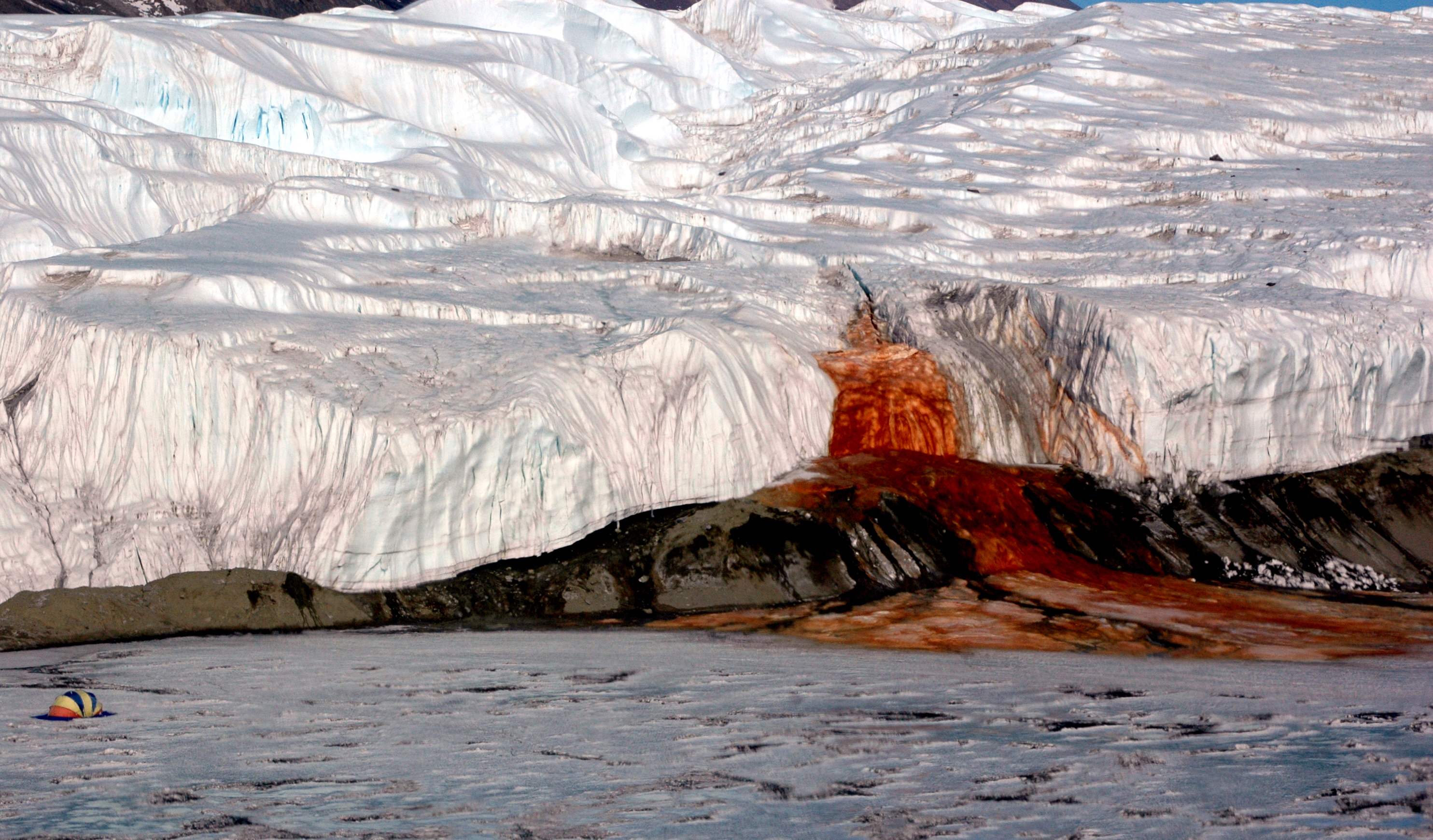
‘ …the discovery of an ecosystem buried under the ice of one of these glaciers that stretches the definition of unusual well past the breaking point… Nobody would be likely to suspect that there is any life underneath the ice, which is hundreds of meters thick in the area, if it weren't for the striking red ice erupting from the glacier's terminus, giving the formation the name Blood Falls. That red color comes from iron concentrated in the ice, which exists primarily in the Fe(II) state favored when oxygen is absent. Thanks to a release event that occurred in 2004, researchers have projected where that iron originates, and suggested its likely source. They've also figured out what the environment at that source looks like… it appears that energy is obtained when sulfur is cycled through different oxidation states by reacting it with iron, producing the Fe(II) seen in the brine. The oxidized sulfur is then used to react with carbon compounds, powering the metabolism. All of that is pretty low-energy—the authors suggest that the doubling time for a bacterium in this environment would be roughly 300 days—and requires an external source of Fe(III) to power the system. The authors posit that the glacier itself might provide the source by extracting new iron as it scrapes across the underlying rocks.’  
Attribution
By National Science Foundation/Peter Rejcek [Public domain], via Wikimedia Commons


References

Periodic Table

Stellar Evolution

Silicon

Hypothetical Types of Biochemistry 

Thursday, March 12, 2015

Explained in Detail

Related posts:
For complete list, see Blog Archive 

Most people tend to not to study the scriptures literally and objectively, resorting instead to other sources to take religious guidance, or to philosophy and metaphysics in their search for God.

The Quran [15:86] claims that it has been sent by Allah, the Master Creator, knowing all things. It also repeatedly insists that it is detailed and diversified. If that is the case, then all information contained in this book must be correct, and it should be able to describe creation accurately. 

People ask what is the point of my blog: http://signsandscience.blogspot.com/ The point of the blog is to study the factual accuracy of the Quran, and thereby verify that it is indeed from the Master Creator. I hope and pray that this blog helps establish how essential it is to study and contemplate upon each verse, without any prejudices or assumptions.

Abstract
Starting with verses 7:52 and 7:58, the relevant verses of the Quran have been collected in this post to help realise the significance of the Quran’s insistence upon itself being well-explained. Life is an open-book exam, and we cannot afford to put off taking guidance from the Quran. As verse 7:53 begins with the question: ‘Do they await except its result?’

Full Text
Billions of Muslims believe the Quran to be a divine scripture. The Quran itself claims to be sent by Allah, the Creator of the Heavens and the Earth and everything in it. It also claims that it is divinely protected from alterations. Thus, all verses in the arabic text of the Quran should be in their original pristine form, as revealed, and must be treated as such by all those who believe the Quran to be divinely revealed. This implies that each word of each verse merits serious attention, as it is a message from the Lord of the Worlds. 

The Quran also repeatedly claims that it is ‘explained in detail’. Verse 15:86 states that it has been sent by the Master Creator, knowing all things. It insists that it is detailed and diversified. Thus, such verses are collected here to study just how many times the Quran insists upon itself being ‘well-explained’ and consequently, to realise how seriously we must consider this text, as the consequence of accepting or rejecting the guidance is also detailed in the Book.  
  
Life is an open-book exam, and we cannot afford to put off taking guidance from the Quran. As verse 7:53 begins with the question: ‘Do they await except its result?’ 


الَّذِينَ اتَّخَذُوا دِينَهُمْ لَهْوًا وَلَعِبًا وَغَرَّتْهُمُ الْحَيَاةُ الدُّنْيَا ۚ فَالْيَوْمَ نَنسَاهُمْ كَمَا نَسُوا لِقَاء  
يَوْمِهِمْ هَـٰذَا وَمَا كَانُوا بِآيَاتِنَا يَجْحَدُونَ 
وَلَقَدْ جِئْنَاهُم بِكِتَابٍ فَصَّلْنَاهُ عَلَىٰ عِلْمٍ هُدًى وَرَحْمَةً لِّقَوْمٍ يُؤْمِنُونَ
هَلْ يَنظُرُونَ إِلَّا تَأْوِيلَهُ ۚ يَوْمَ يَأْتِي تَأْوِيلُهُ يَقُولُ الَّذِينَ نَسُوهُ مِن قَبْلُ قَدْ جَاءَتْ رُسُلُ رَبِّنَا بِالْحَقِّ فَهَل لَّنَا مِن شُفَعَاءَ فَيَشْفَعُوا لَنَا أَوْ نُرَدُّ فَنَعْمَلَ غَيْرَ الَّذِي كُنَّا نَعْمَلُ ۚ قَدْ خَسِرُوا أَنفُسَهُمْ وَضَلَّ عَنْهُم مَّا كَانُوا يَفْتَرُونَ
[Al-Qur’an 7:51-53, translator: Sahih International] Who took their religion as distraction and amusement and whom the worldly life deluded." So today We will forget them just as they forgot the meeting of this Day of theirs and for having rejected Our verses. And We had certainly brought them a Book which We detailed by knowledge - as guidance and mercy to a people who believe. Do they await except its result? The Day its result comes those who had ignored it before will say, "The messengers of our Lord had come with the truth, so are there [now] any intercessors to intercede for us or could we be sent back to do other than we used to do?" They will have lost themselves, and lost from them is what they used to invent. 

(6:55:2) nufaṣṣilu We explain وَكَذَٰلِكَ نُفَصِّلُ الْآيَاتِ وَلِتَسْتَبِينَ سَبِيلُ الْمُجْرِمِينَ
(6:97:13) faṣṣalnā We have made clear قَدْ فَصَّلْنَا الْآيَاتِ لِقَوْمٍ يَعْلَمُونَ
(6:98:10) faṣṣalnā We have made clear فَمُسْتَقَرٌّ وَمُسْتَوْدَعٌ قَدْ فَصَّلْنَا الْآيَاتِ لِقَوْمٍ يَفْقَهُونَ
(6:119:11) faṣṣala He (has) explained in detail وَمَا لَكُمْ أَلَّا تَأْكُلُوا مِمَّا ذُكِرَ اسْمُ اللَّهِ عَلَيْهِ وَقَدْ فَصَّلَ لَكُمْ مَا حَرَّمَ عَلَيْكُمْ
(6:126:6) faṣṣalnā We have detailed وَهَٰذَا صِرَاطُ رَبِّكَ مُسْتَقِيمًا قَدْ فَصَّلْنَا الْآيَاتِ لِقَوْمٍ يَذَّكَّرُونَ
(7:32:23) nufaṣṣilu We explain كَذَٰلِكَ نُفَصِّلُ الْآيَاتِ لِقَوْمٍ يَعْلَمُونَ
(7:52:4) faṣṣalnāhu which We have explained وَلَقَدْ جِئْنَاهُمْ بِكِتَابٍ فَصَّلْنَاهُ عَلَىٰ عِلْمٍ
(7:174:2) nufaṣṣilu We explain وَكَذَٰلِكَ نُفَصِّلُ الْآيَاتِ وَلَعَلَّهُمْ يَرْجِعُونَ
(9:11:10) wanufaṣṣilu And We explain in detail فَإِخْوَانُكُمْ فِي الدِّينِ وَنُفَصِّلُ الْآيَاتِ لِقَوْمٍ يَعْلَمُونَ
(10:5:20) yufaṣṣilu He explains مَا خَلَقَ اللَّهُ ذَٰلِكَ إِلَّا بِالْحَقِّ يُفَصِّلُ الْآيَاتِ لِقَوْمٍ يَعْلَمُونَ
(10:24:40) nufaṣṣilu We explain كَذَٰلِكَ نُفَصِّلُ الْآيَاتِ لِقَوْمٍ يَتَفَكَّرُونَ
(11:1:6) fuṣṣilat explained in detail الر كِتَابٌ أُحْكِمَتْ آيَاتُهُ ثُمَّ فُصِّلَتْ مِنْ لَدُنْ حَكِيمٍ خَبِيرٍ
(13:2:21) yufaṣṣilu He details يُدَبِّرُ الْأَمْرَ يُفَصِّلُ الْآيَاتِ لَعَلَّكُمْ بِلِقَاءِ رَبِّكُمْ تُوقِنُونَ
(17:12:22) faṣṣalnāhu We have explained it وَلِتَعْلَمُوا عَدَدَ السِّنِينَ وَالْحِسَابَ وَكُلَّ شَيْءٍ فَصَّلْنَاهُ تَفْصِيلًا
(30:28:24) nufaṣṣilu We explain كَذَٰلِكَ نُفَصِّلُ الْآيَاتِ لِقَوْمٍ يَعْقِلُونَ
(41:3:2) fuṣṣilat are detailed كِتَابٌ فُصِّلَتْ آيَاتُهُ قُرْآنًا عَرَبِيًّا لِقَوْمٍ يَعْلَمُونَ
(41:44:7) fuṣṣilat are explained in detail وَلَوْ جَعَلْنَاهُ قُرْآنًا أَعْجَمِيًّا لَقَالُوا لَوْلَا فُصِّلَتْ آيَاتُهُ

The triliteral root fā ṣād lām (ف ص ل) occurs 43 times in the Quran, in nine derived forms:
five times as the form I verb faṣala (فَصَلَ)
17 times as the form II verb faṣṣala (فَصَّلَ)
three times as the noun fiṣāl (فِصَال)
nine times as the nominal faṣl (فَصْل)
once as the noun faṣīlat (فَصِيلَت)
once as the adjective mufaṣṣalāt (مُّفَصَّلَٰت)
once as the active participle fāṣilīn (فَٰصِلِين)
five times as the form II verbal noun tafṣīl (تَفْصِيل)
once as the form II passive participle mufaṣṣal (مُفَصَّل)
The translations below are brief glosses intended as a guide to meaning. An Arabic word may have a range of meanings depending on context. Click on a word for more linguistic information, or to suggestion a correction.

Verb (form I) - to set out, to depart, to judge
(2:249:2) faṣala set out فَلَمَّا فَصَلَ طَالُوتُ بِالْجُنُودِ قَالَ إِنَّ اللَّهَ مُبْتَلِيكُمْ بِنَهَرٍ
(12:94:2) faṣalati departed وَلَمَّا فَصَلَتِ الْعِيرُ قَالَ أَبُوهُمْ إِنِّي لَأَجِدُ رِيحَ يُوسُفَ
(22:17:13) yafṣilu will judge إِنَّ اللَّهَ يَفْصِلُ بَيْنَهُمْ يَوْمَ الْقِيَامَةِ
(32:25:4) yafṣilu will judge إِنَّ رَبَّكَ هُوَ يَفْصِلُ بَيْنَهُمْ يَوْمَ الْقِيَامَةِ فِيمَا كَانُوا فِيهِ يَخْتَلِفُونَ
(60:3:8) yafṣilu He will judge لَنْ تَنْفَعَكُمْ أَرْحَامُكُمْ وَلَا أَوْلَادُكُمْ يَوْمَ الْقِيَامَةِ يَفْصِلُ بَيْنَكُمْ
Verb (form II) - to make clear, to explain in detail
(6:55:2) nufaṣṣilu We explain وَكَذَٰلِكَ نُفَصِّلُ الْآيَاتِ وَلِتَسْتَبِينَ سَبِيلُ الْمُجْرِمِينَ
(6:97:13) faṣṣalnā We have made clear قَدْ فَصَّلْنَا الْآيَاتِ لِقَوْمٍ يَعْلَمُونَ
(6:98:10) faṣṣalnā We have made clear فَمُسْتَقَرٌّ وَمُسْتَوْدَعٌ قَدْ فَصَّلْنَا الْآيَاتِ لِقَوْمٍ يَفْقَهُونَ
(6:119:11) faṣṣala He (has) explained in detail وَمَا لَكُمْ أَلَّا تَأْكُلُوا مِمَّا ذُكِرَ اسْمُ اللَّهِ عَلَيْهِ وَقَدْ فَصَّلَ لَكُمْ مَا حَرَّمَ عَلَيْكُمْ
(6:126:6) faṣṣalnā We have detailed وَهَٰذَا صِرَاطُ رَبِّكَ مُسْتَقِيمًا قَدْ فَصَّلْنَا الْآيَاتِ لِقَوْمٍ يَذَّكَّرُونَ
(7:32:23) nufaṣṣilu We explain كَذَٰلِكَ نُفَصِّلُ الْآيَاتِ لِقَوْمٍ يَعْلَمُونَ
(7:52:4) faṣṣalnāhu which We have explained وَلَقَدْ جِئْنَاهُمْ بِكِتَابٍ فَصَّلْنَاهُ عَلَىٰ عِلْمٍ
(7:174:2) nufaṣṣilu We explain وَكَذَٰلِكَ نُفَصِّلُ الْآيَاتِ وَلَعَلَّهُمْ يَرْجِعُونَ
(9:11:10) wanufaṣṣilu And We explain in detail فَإِخْوَانُكُمْ فِي الدِّينِ وَنُفَصِّلُ الْآيَاتِ لِقَوْمٍ يَعْلَمُونَ
(10:5:20) yufaṣṣilu He explains مَا خَلَقَ اللَّهُ ذَٰلِكَ إِلَّا بِالْحَقِّ يُفَصِّلُ الْآيَاتِ لِقَوْمٍ يَعْلَمُونَ
(10:24:40) nufaṣṣilu We explain كَذَٰلِكَ نُفَصِّلُ الْآيَاتِ لِقَوْمٍ يَتَفَكَّرُونَ
(11:1:6) fuṣṣilat explained in detail الر كِتَابٌ أُحْكِمَتْ آيَاتُهُ ثُمَّ فُصِّلَتْ مِنْ لَدُنْ حَكِيمٍ خَبِيرٍ
(13:2:21) yufaṣṣilu He details يُدَبِّرُ الْأَمْرَ يُفَصِّلُ الْآيَاتِ لَعَلَّكُمْ بِلِقَاءِ رَبِّكُمْ تُوقِنُونَ
(17:12:22) faṣṣalnāhu We have explained it وَلِتَعْلَمُوا عَدَدَ السِّنِينَ وَالْحِسَابَ وَكُلَّ شَيْءٍ فَصَّلْنَاهُ تَفْصِيلًا
(30:28:24) nufaṣṣilu We explain كَذَٰلِكَ نُفَصِّلُ الْآيَاتِ لِقَوْمٍ يَعْقِلُونَ
(41:3:2) fuṣṣilat are detailed كِتَابٌ فُصِّلَتْ آيَاتُهُ قُرْآنًا عَرَبِيًّا لِقَوْمٍ يَعْلَمُونَ
(41:44:7) fuṣṣilat are explained in detail وَلَوْ جَعَلْنَاهُ قُرْآنًا أَعْجَمِيًّا لَقَالُوا لَوْلَا فُصِّلَتْ آيَاتُهُ
Noun
(2:233:36) fiṣālan weaning فَإِنْ أَرَادَا فِصَالًا عَنْ تَرَاضٍ مِنْهُمَا وَتَشَاوُرٍ فَلَا جُنَاحَ عَلَيْهِمَا
(31:14:9) wafiṣāluhu and his weaning حَمَلَتْهُ أُمُّهُ وَهْنًا عَلَىٰ وَهْنٍ وَفِصَالُهُ فِي عَامَيْنِ
(46:15:11) wafiṣāluhu and (the) weaning of him حَمَلَتْهُ أُمُّهُ كُرْهًا وَوَضَعَتْهُ كُرْهًا وَحَمْلُهُ وَفِصَالُهُ ثَلَاثُونَ شَهْرًا
Nominal
(1) Noun
(37:21:3) l-faṣli (of) Judgment هَٰذَا يَوْمُ الْفَصْلِ الَّذِي كُنْتُمْ بِهِ تُكَذِّبُونَ
(38:20:5) wafaṣla and decisive وَشَدَدْنَا مُلْكَهُ وَآتَيْنَاهُ الْحِكْمَةَ وَفَصْلَ الْخِطَابِ
(42:21:15) l-faṣli decisive وَلَوْلَا كَلِمَةُ الْفَصْلِ لَقُضِيَ بَيْنَهُمْ وَإِنَّ الظَّالِمِينَ لَهُمْ عَذَابٌ أَلِيمٌ
(44:40:3) l-faṣli (the) Day of Judgment إِنَّ يَوْمَ الْفَصْلِ مِيقَاتُهُمْ أَجْمَعِينَ
(77:13:2) l-faṣli (of) Judgment لِيَوْمِ الْفَصْلِ
(77:14:5) l-faṣli (of) the Judgment وَمَا أَدْرَاكَ مَا يَوْمُ الْفَصْلِ
(77:38:3) l-faṣli (of) Judgment هَٰذَا يَوْمُ الْفَصْلِ جَمَعْنَاكُمْ وَالْأَوَّلِينَ
(78:17:3) l-faṣli (of) the Judgment إِنَّ يَوْمَ الْفَصْلِ كَانَ مِيقَاتًا
(2) Adjective
(86:13:3) faṣlun decisive إِنَّهُ لَقَوْلٌ فَصْلٌ
Noun
(70:13:1) wafaṣīlatihi And his nearest kindred وَفَصِيلَتِهِ الَّتِي تُؤْوِيهِ
Adjective
(7:133:9) mufaṣṣalātin manifest فَأَرْسَلْنَا عَلَيْهِمُ الطُّوفَانَ وَالْجَرَادَ وَالْقُمَّلَ وَالضَّفَادِعَ وَالدَّمَ آيَاتٍ مُفَصَّلَاتٍ
Active participle
(6:57:22) l-fāṣilīna (of) the Deciders إِنِ الْحُكْمُ إِلَّا لِلَّهِ يَقُصُّ الْحَقَّ وَهُوَ خَيْرُ الْفَاصِلِينَ
Verbal noun (form II)
(6:154:9) watafṣīlan and an explanation ثُمَّ آتَيْنَا مُوسَى الْكِتَابَ تَمَامًا عَلَى الَّذِي أَحْسَنَ وَتَفْصِيلًا لِكُلِّ شَيْءٍ
(7:145:9) watafṣīlan and explanation وَكَتَبْنَا لَهُ فِي الْأَلْوَاحِ مِنْ كُلِّ شَيْءٍ مَوْعِظَةً وَتَفْصِيلًا لِكُلِّ شَيْءٍ
(10:37:15) watafṣīla and a detailed explanation وَلَٰكِنْ تَصْدِيقَ الَّذِي بَيْنَ يَدَيْهِ وَتَفْصِيلَ الْكِتَابِ لَا رَيْبَ فِيهِ
(12:111:17) watafṣīla and a detailed explanation وَلَٰكِنْ تَصْدِيقَ الَّذِي بَيْنَ يَدَيْهِ وَتَفْصِيلَ كُلِّ شَيْءٍ
(17:12:23) tafṣīlan (in) detail وَلِتَعْلَمُوا عَدَدَ السِّنِينَ وَالْحِسَابَ وَكُلَّ شَيْءٍ فَصَّلْنَاهُ تَفْصِيلًا
Passive participle (form II)
(6:114:10) mufaṣṣalan explained in detail وَهُوَ الَّذِي أَنْزَلَ إِلَيْكُمُ الْكِتَابَ مُفَصَّلًا


وَالْبَلَدُ الطَّيِّبُ يَخْرُجُ نَبَاتُهُ بِإِذْنِ رَبِّهِ ۖ وَالَّذِي خَبُثَ لَا يَخْرُجُ إِلَّا نَكِدًا 
كَذَ‌ٰلِكَ نُصَرِّفُ الْآيَاتِ لِقَوْمٍ يَشْكُرُونَ

[Al-Qur’an 7:58, translator: Sahih International] And the good land - its vegetation emerges by permission of its Lord; but that which is bad - nothing emerges except sparsely, with difficulty. Thus do We diversify the signs for a people who are grateful. 


(6:46:19) nuṣarrifu We explain انْظُرْ كَيْفَ نُصَرِّفُ الْآيَاتِ ثُمَّ هُمْ يَصْدِفُونَ
(6:65:24) nuṣarrifu We explain انْظُرْ كَيْفَ نُصَرِّفُ الْآيَاتِ لَعَلَّهُمْ يَفْقَهُونَ
(6:105:2) nuṣarrifu We explain وَكَذَٰلِكَ نُصَرِّفُ الْآيَاتِ وَلِيَقُولُوا دَرَسْتَ
(7:58:14) nuṣarrifu We explain كَذَٰلِكَ نُصَرِّفُ الْآيَاتِ لِقَوْمٍ يَشْكُرُونَ
(17:41:2) ṣarrafnā We have explained وَلَقَدْ صَرَّفْنَا فِي هَٰذَا الْقُرْآنِ لِيَذَّكَّرُوا
(17:89:2) ṣarrafnā We have explained وَلَقَدْ صَرَّفْنَا لِلنَّاسِ فِي هَٰذَا الْقُرْآنِ مِنْ كُلِّ مَثَلٍ
(18:54:2) ṣarrafnā We have explained وَلَقَدْ صَرَّفْنَا فِي هَٰذَا الْقُرْآنِ لِلنَّاسِ مِنْ كُلِّ مَثَلٍ
(20:113:5) waṣarrafnā and We have explained وَكَذَٰلِكَ أَنْزَلْنَاهُ قُرْآنًا عَرَبِيًّا وَصَرَّفْنَا فِيهِ مِنَ الْوَعِيدِ
(25:50:2) ṣarrafnāhu We have distributed it وَلَقَدْ صَرَّفْنَاهُ بَيْنَهُمْ لِيَذَّكَّرُوا
(46:27:7) waṣarrafnā and We have diversified وَصَرَّفْنَا الْآيَاتِ لَعَلَّهُمْ يَرْجِعُونَ

The triliteral root ṣād rā fā (ص ر ف) occurs 30 times in the Quran, in seven derived forms:
14 times as the form I verb ṣarafa (صَرَفَ)
10 times as the form II verb ṣarraf (صَرَّفْ)
once as the form VII verb inṣarafu (ٱنصَرَفُ)
once as the noun ṣarf (صَرْف)
once as the noun maṣrif (مَصْرِف)
once as the passive participle maṣrūf (مَصْرُوف)
twice as the form II verbal noun taṣrīf (تَصْرِيف)
The translations below are brief glosses intended as a guide to meaning. An Arabic word may have a range of meanings depending on context. Click on a word for more linguistic information, or to suggestion a correction.

Verb (form I) - to divert, to turn away
(3:152:30) ṣarafakum He diverted you ثُمَّ صَرَفَكُمْ عَنْهُمْ لِيَبْتَلِيَكُمْ وَلَقَدْ عَفَا عَنْكُمْ
(6:16:2) yuṣ'raf is averted مَنْ يُصْرَفْ عَنْهُ يَوْمَئِذٍ فَقَدْ رَحِمَهُ وَذَٰلِكَ الْفَوْزُ الْمُبِينُ
(7:47:2) ṣurifat are turned وَإِذَا صُرِفَتْ أَبْصَارُهُمْ تِلْقَاءَ أَصْحَابِ النَّارِ قَالُوا رَبَّنَا لَا تَجْعَلْنَا مَعَ الْقَوْمِ الظَّالِمِينَ
(7:146:1) sa-aṣrifu I will turn away سَأَصْرِفُ عَنْ آيَاتِيَ الَّذِينَ يَتَكَبَّرُونَ فِي الْأَرْضِ
(9:127:15) ṣarafa Allah has turned away صَرَفَ اللَّهُ قُلُوبَهُمْ بِأَنَّهُمْ قَوْمٌ لَا يَفْقَهُونَ
(10:32:11) tuṣ'rafūna (are) you turned away فَمَاذَا بَعْدَ الْحَقِّ إِلَّا الضَّلَالُ فَأَنَّىٰ تُصْرَفُونَ
(12:24:12) linaṣrifa that We might avert كَذَٰلِكَ لِنَصْرِفَ عَنْهُ السُّوءَ وَالْفَحْشَاءَ
(12:33:10) taṣrif You turn away وَإِلَّا تَصْرِفْ عَنِّي كَيْدَهُنَّ أَصْبُ إِلَيْهِنَّ
(12:34:4) faṣarafa and turned away فَاسْتَجَابَ لَهُ رَبُّهُ فَصَرَفَ عَنْهُ كَيْدَهُنَّ
(24:43:30) wayaṣrifuhu and averts it فَيُصِيبُ بِهِ مَنْ يَشَاءُ وَيَصْرِفُهُ عَنْ مَنْ يَشَاءُ
(25:65:4) iṣ'rif Avert وَالَّذِينَ يَقُولُونَ رَبَّنَا اصْرِفْ عَنَّا عَذَابَ جَهَنَّمَ
(39:6:36) tuṣ'rafūna are you turning away ذَٰلِكُمُ اللَّهُ رَبُّكُمْ لَهُ الْمُلْكُ لَا إِلَٰهَ إِلَّا هُوَ فَأَنَّىٰ تُصْرَفُونَ
(40:69:10) yuṣ'rafūna they are turned away أَلَمْ تَرَ إِلَى الَّذِينَ يُجَادِلُونَ فِي آيَاتِ اللَّهِ أَنَّىٰ يُصْرَفُونَ
(46:29:2) ṣarafnā We directed وَإِذْ صَرَفْنَا إِلَيْكَ نَفَرًا مِنَ الْجِنِّ يَسْتَمِعُونَ الْقُرْآنَ
Verb (form II) - to explain
(6:46:19) nuṣarrifu We explain انْظُرْ كَيْفَ نُصَرِّفُ الْآيَاتِ ثُمَّ هُمْ يَصْدِفُونَ
(6:65:24) nuṣarrifu We explain انْظُرْ كَيْفَ نُصَرِّفُ الْآيَاتِ لَعَلَّهُمْ يَفْقَهُونَ
(6:105:2) nuṣarrifu We explain وَكَذَٰلِكَ نُصَرِّفُ الْآيَاتِ وَلِيَقُولُوا دَرَسْتَ
(7:58:14) nuṣarrifu We explain كَذَٰلِكَ نُصَرِّفُ الْآيَاتِ لِقَوْمٍ يَشْكُرُونَ
(17:41:2) ṣarrafnā We have explained وَلَقَدْ صَرَّفْنَا فِي هَٰذَا الْقُرْآنِ لِيَذَّكَّرُوا
(17:89:2) ṣarrafnā We have explained وَلَقَدْ صَرَّفْنَا لِلنَّاسِ فِي هَٰذَا الْقُرْآنِ مِنْ كُلِّ مَثَلٍ
(18:54:2) ṣarrafnā We have explained وَلَقَدْ صَرَّفْنَا فِي هَٰذَا الْقُرْآنِ لِلنَّاسِ مِنْ كُلِّ مَثَلٍ
(20:113:5) waṣarrafnā and We have explained وَكَذَٰلِكَ أَنْزَلْنَاهُ قُرْآنًا عَرَبِيًّا وَصَرَّفْنَا فِيهِ مِنَ الْوَعِيدِ
(25:50:2) ṣarrafnāhu We have distributed it وَلَقَدْ صَرَّفْنَاهُ بَيْنَهُمْ لِيَذَّكَّرُوا
(46:27:7) waṣarrafnā and We have diversified وَصَرَّفْنَا الْآيَاتِ لَعَلَّهُمْ يَرْجِعُونَ
Verb (form VII) - to turn away
(9:127:14) inṣarafū they turn away ثُمَّ انْصَرَفُوا صَرَفَ اللَّهُ قُلُوبَهُمْ
Noun
(25:19:7) ṣarfan (to) avert فَقَدْ كَذَّبُوكُمْ بِمَا تَقُولُونَ فَمَا تَسْتَطِيعُونَ صَرْفًا وَلَا نَصْرًا
Noun
(18:53:10) maṣrifan a way of escape فَظَنُّوا أَنَّهُمْ مُوَاقِعُوهَا وَلَمْ يَجِدُوا عَنْهَا مَصْرِفًا
Passive participle
(11:8:15) maṣrūfan (will be) averted أَلَا يَوْمَ يَأْتِيهِمْ لَيْسَ مَصْرُوفًا عَنْهُمْ
Verbal noun (form II)
(2:164:34) wataṣrīfi and directing وَتَصْرِيفِ الرِّيَاحِ وَالسَّحَابِ الْمُسَخَّرِ بَيْنَ السَّمَاءِ وَالْأَرْضِ لَآيَاتٍ لِقَوْمٍ يَعْقِلُونَ
(45:5:16) wataṣrīfi and (in) directing وَتَصْرِيفِ الرِّيَاحِ آيَاتٌ لِقَوْمٍ يَعْقِلُونَ


References


Multiple Translations: